

Grounded in research. Rooted in experience.
Our Philosophy
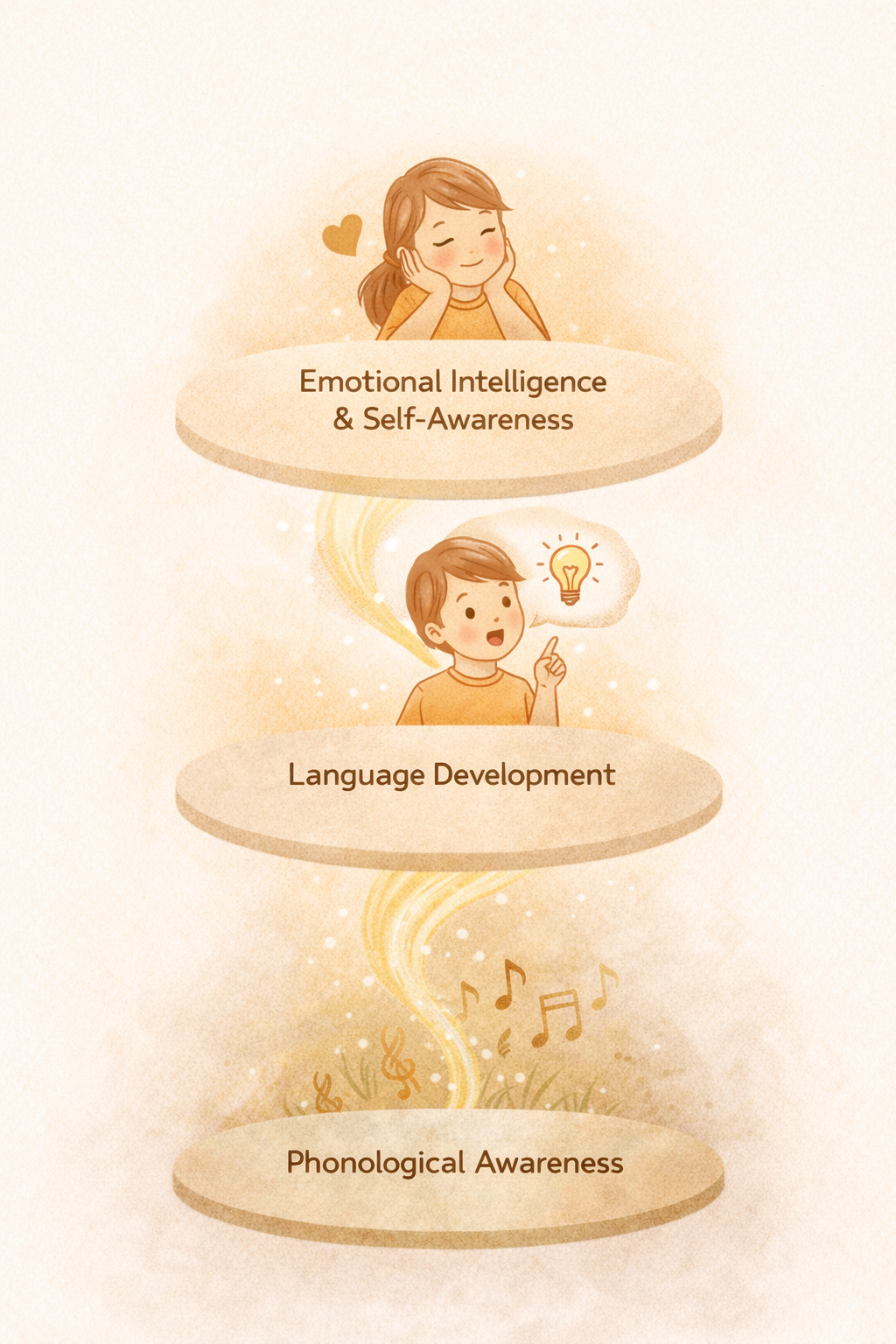
1. Emotional Intelligence is the Foundation
Daniel Goleman's research on emotional intelligence showed us that the ability to recognise, understand, and manage emotions—both our own and others'—is more important to life success than academic achievement alone. Children who can regulate themselves, communicate their needs, and understand others are children who can learn.
Here's the thing: emotional intelligence requires language. You can't name what you're feeling if you don't have the words. You can't solve a problem if you can't articulate it. You can't connect with others if you can't express yourself.
Heart Start is built on three intersecting ideas:
2. Language Shapes Thought
There's a concept from linguistics called the Sapir-Whorf hypothesis: the language we have available shapes how we think, what we notice, and what we can understand.
Think of it this way: if a child has only vague words for emotions (like "bad" or "upset"), they can only think about emotions in vague ways. But if they have precise words ("frustrated," "embarrassed," "overwhelmed," "proud"), they can recognise those feelings in themselves and understand them in others. Their capacity for emotional intelligence literally expands with their vocabulary.
The same is true for every area of learning. A child with rich language can think more deeply, express more clearly, and understand more fully.
3. Phonological Awareness is the Gateway
Phonological awareness—the ability to recognise and play with sounds in language—is the foundation of reading. It's the building block for language development itself.
When children develop strong phonological awareness, they're not just learning to read. They're developing the precise relationship between sounds and meaning that underlies all language. They're building the neural pathways that support language processing, self-expression, and thought itself.
That's why we start here. Not because reading is the only important skill, but because language—beginning with the sounds that make up words—is the foundation for everything else.